
Shaped by people with spinal cord injury, study puts exercise to the test for chronic pain
More than 150 individuals and 50 clinicians helped design the trial, which found promising but mixed results.
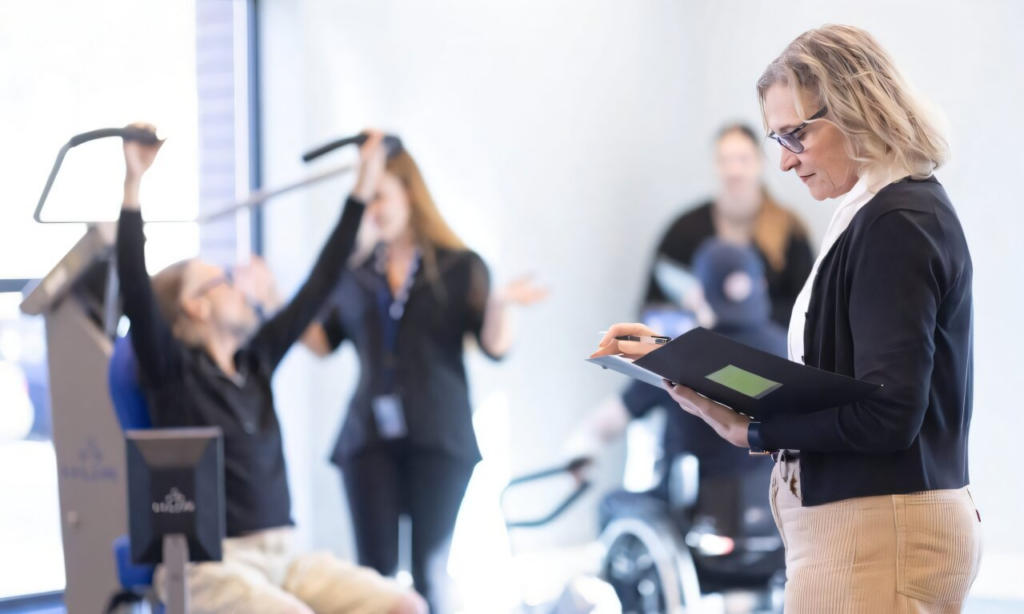
Dr. Kathleen Martin Ginis, right, monitors research participants at UBC Okanagan in Kelowna. Credit: University of British Columbia
by David Bidwell, University of British Columbia, October 16, 2026
Exercise prescribed according to international spinal cord injury guidelines can reduce the intensity of chronic pain when done in everyday settings, according to a new UBC Okanagan–led clinical trial.
The study, published in the Archives of Physical Medicine and Rehabilitation, is the first randomized controlled trial to test whether the guidelines can specifically help reduce chronic pain. Most people living with a spinal cord injury experience chronic pain, and many say it is more debilitating than the injury itself. Medications are the most common treatment, but they carry side effects and help only some people.
“People with spinal cord injury have told us for years that they use exercise to manage their pain, but we didn’t have strong evidence on how to prescribe it,” says lead author Dr. Kathleen Martin Ginis, a professor in the School of Health and Exercise Sciences and holder of the Reichwald Family UBC Southern Medical Program Chair in Preventive Medicine.
The trial enrolled 46 adults with spinal cord injury and chronic neuropathic or musculoskeletal pain. Half received a personalized aerobic and strength program, with support from certified fitness trainers and weekly exercise counseling. The others continued their usual activities. Participants exercised where it suited them, at home, local gyms or community centers.
On the study’s primary measure of pain, which combines pain severity and interference, the results were inconclusive. But on a spinal cord injury–specific measure of pain intensity, the exercise group reported significant decreases at three and six months compared with the control group.
At six months, eight of 18 exercise participants had a clinically meaningful reduction in pain intensity of 30% or more, compared with two of 16 in the control group. The exercise group also reported less pain interference with daily activities and mood at three months, and greater vitality.
Responses varied widely. Some participants saw large drops in pain, while others saw little change or an increase. Participants met the aerobic prescription more consistently than the strength prescription, and the team says aerobic exercise may be especially important.
“This isn’t a cure-all, and we need larger trials to confirm these findings,” says Martin Ginis. “But it shows that a standardized exercise prescription can be delivered in real-world settings and may offer a drug-free option for some people.”
The study was shaped by more than 150 people with spinal cord injury and 50 clinicians. It was also repeatedly interrupted by COVID-19 restrictions and wildfire evacuations, which limited recruitment to fewer participants than the 84 originally planned. Testing took place at the UBC campuses in Kelowna and Vancouver.
Co-authors from UBC include Drs. Femke Hoekstra, Julia Baumgart, Jonathan Little and Kendra Todd from the UBCO School of Health and Exercise Sciences, Dr. Jennifer Davis from the UBCO Faculty of Management, as well as, Drs. Christopher West and John Kramer from the UBC Faculty of Medicine.
They worked with supporting units from UBC’s Vancouver campus, including the International Collaboration on Repair Discoveries and the Center for Advancing Health Outcomes.
 Source University of British Columbia
| References |
Martin Ginis KA, van der Ploeg HP, Foster C, Lai B, McBride CB, Ng K, Pratt M, Shirazipour CH, Smith B, Vásquez PM, Heath GW. Participation of people living with disabilities in physical activity: a global perspective. The Lancet. 2021 Jul 31;398(10298):443-455. doi: 10.1016/S0140-6736(21)01164-8. Epub 2021 Jul 21. Full text