
Research moves closer to ‘smart’ sensors in knee replacements
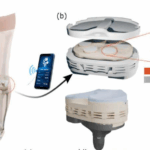
Piezoelectric and triboelectric transducers would convert the knee’s movements into small amounts of power that would power sensors. Credit: Binghamton University
by Chris Kocher, Binghamton University, edited by Gaby Clark, reviewed by Robert Egan
If you have a knee replacement, imagine pointing your phone at your knee and pulling up an app that tells you how much stress the artificial joint is experiencing. Knowing the activities that cause the biggest problems—which can lead to a second replacement surgery—would be invaluable. Research led by Binghamton University is closer to making this technology a reality.
Professor Shahrzad “Sherry” Towfighian—a faculty member from the Thomas J. Watson College of Engineering and Applied Science’s Department of Mechanical Engineering—has worked toward “smart-knee” tech over the past decade.
According to the American College of Rheumatology, nearly 800,000 total knee replacements are done every year in the U.S., and that number is expected to rise sharply by 2030 as the population ages and sports injuries become more common.
“These implants should last for the rest of their lives. They don’t want revision surgery, but one in five patients has loosening or imbalance in the joint,” Towfighian said. “We need to solve this issue, because right now there are no sensors inside the implant to show any indication of problems, and then it becomes too late to fix it. The ability to noninvasively measure loads using embedded sensors would enable earlier identification of aberrant loading and the development of treatment strategies.”
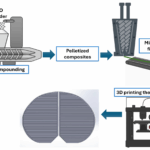
Fabrication process of the TPU composites. Credit: Sensors (2025). DOI: 10.3390/s25206454
Powering these sensors would be piezoelectric and triboelectric transducers, which convert the knee’s movements into small amounts of power.
Recently published papers from Towfighian and Ph.D. candidates Mahmood Chahari, Osama Abdalla, and Elham Mahmoudi in the journals Nano Energy, Sensors, and IEEE/ASME Transactions on Mechatronics focus on the best transduction materials and designs for energy harvesting-based load sensors.
For the best results, the answer to “smart knee” implants seems to be a combination of triboelectric generation (when two objects contact or slide against each other) and piezoelectric generation (which relies on vibrations and pressure). Different materials offer a range of sensor sensitivities as well.
“Because the output of the harvester is proportional to the load that it receives, it serves both as a sensor and an energy harvester,” Towfighian said. “As state-of-the-art power management and wireless communication circuits can operate in the microwatt range that the harvester produces, it is possible to create a self-powered load sensor.”
Contributors to this research include colleagues at Stony Brook University and Western University in London, Canada.
“We compared our results with a joint simulator from Associate Professor Ryan Willing, our collaborator at Western University. It simulates the six degrees of freedom in the knee joint,” Towfighian said. “In terms of the performance, we think we have characterized it well. The part that remains is to seal the device and test it on cadaveric legs to ensure biocompatibility and accurate sensor performance.”
| Publication details |
Chahari M, Salman E, Stanacevic M, Willing R, Towfighian S. Performance of piezoelectric and triboelectric transducers under gait loading for energy harvesting and load monitoring in total knee replacements. Nano Energy. 2025 Aug;141:111117. doi: 10.1016/j.nanoen.2025.111117. Epub 2025 May 11. PMID: 40896301; PMCID: PMC12393820.
Abdalla O, Azami M, Ameli A, Salman E, Stanacevic M, Willing R, Towfighian S. Experimental Investigation of 3D-Printed TPU Triboelectric Composites for Biomechanical Energy Conversion in Knee Implants. Sensors (Basel). 2025 Oct 18;25(20):6454. doi: 10.3390/s25206454. PMID: 41157506; PMCID: PMC12568253.
Mahmoudi E, Redgrift AG, Salman E, Stanacevic M, Willing R, Towfighian S. Porous Triboelectric Nanogenerator for Load Sensing of Total Knee Replacement. IEEE ASME Trans Mechatron. 2026 Jan 23:10.1109/tmech.2025.3650092. doi: 10.1109/tmech.2025.3650092. Epub ahead of print. PMID: 41674665; PMCID: PMC12889876.
| Related References |
Sekeroglu MO, Pekgor M, Algin A, Toros T, Serin E, Uzun M, Cerit G, Onat T, Ermis SA. Transdisciplinary Innovations in Athlete Health: 3D-Printable Wearable Sensors for Health Monitoring and Sports Psychology. Sensors (Basel). 2025 Feb 27;25(5):1453. doi: 10.3390/s25051453. PMID: 40096328; PMCID: PMC11902809.
Li W, Feng J, Feng G, Feng S. Wearable technology for athletes: material innovations, performance monitoring, and emerging paradigms. Mikrochim Acta. 2026 Jan 8;193(2):76. doi: 10.1007/s00604-025-07792-9. PMID: 41501237.
| Provided by Binghamton University |
Source Medical Xpress