
Researchers want to know how people with multiple sclerosis might be helped by playing Tetris
Researchers are looking for people with multiple sclerosis to be a part of the Tetris study.
| This McMaster study has participants with MS play Tetris |
| A study that aims to improve balance in people with multiple sclerosis is ongoing at McMaster University in Hamilton. The study has people hooked up to a computer and play classic videogame Tetris with their body. CBC |
Aura Carreño Rosas, CBC News Hamilton Jan 09, 2026
Diane Bouwman, diagnosed with multiple sclerosis in 2001, said the disease can make you lose your confidence.
“I’ve had so many falls,” she told CBC Hamilton.
“That’s the biggest thing you lose, your confidence, the more you fall.”
Thanks to a McMaster University research program, playing the classic video game Tetris, helped her get it back.
Multiple sclerosis, or MS, is a neurological disease of the central nervous system. It makes the immune system attack myelin — a membrane which covers the nerves. The most common symptoms include fatigue, poor balance, weakness, tingling or numbness, vision problems and mood changes, according to MS Canada.
MS has no cure and can get worse over the years through different stages.
Bouwman joined the study in February 2024 and, for 6 weeks, she travelled to Hamilton from her home in Kitchener, Ont., three times per week, got her body hooked up to a computer, and played Tetris.
Stephen Toepp, who came up with the study, said he was trying to develop an accessible way to exercise instead of more traditional methods like lifting weights.
Toepp is a PhD fellow at McMaster’s department of kinesiology. He said participants connect to a computer, and are asked to make specific movements that are linked to Tetris inputs.
“Those movements are tailored based on what we’re trying to improve,” he said.
Then, the participants play the game by performing body movements.
“The point isn’t necessarily to play the game,” said Toepp. “The point is to put them in a position that is challenging.”
McMaster’s Neuro Lab is currently looking for more participants diagnosed with MS to continue the study. Those interested can visit the lab’s website and email Toepp.
| Women three times more likely to be diagnosed with MS |
Canada has one of the highest rates of MS in the world, according to the MS International Federation. It is estimated that around 90,000 Canadians have the disease, according to MS Canada.
Bouwman said her symptoms came on “very suddenly.”
“Over the course of four days, numbness and tingling traveled from the base of my feet up the left side of my body into my arm, into my face and I thought I was having a stroke,” she said.
It took some back and forth before she was diagnosed, and even then she didn’t know what it was.
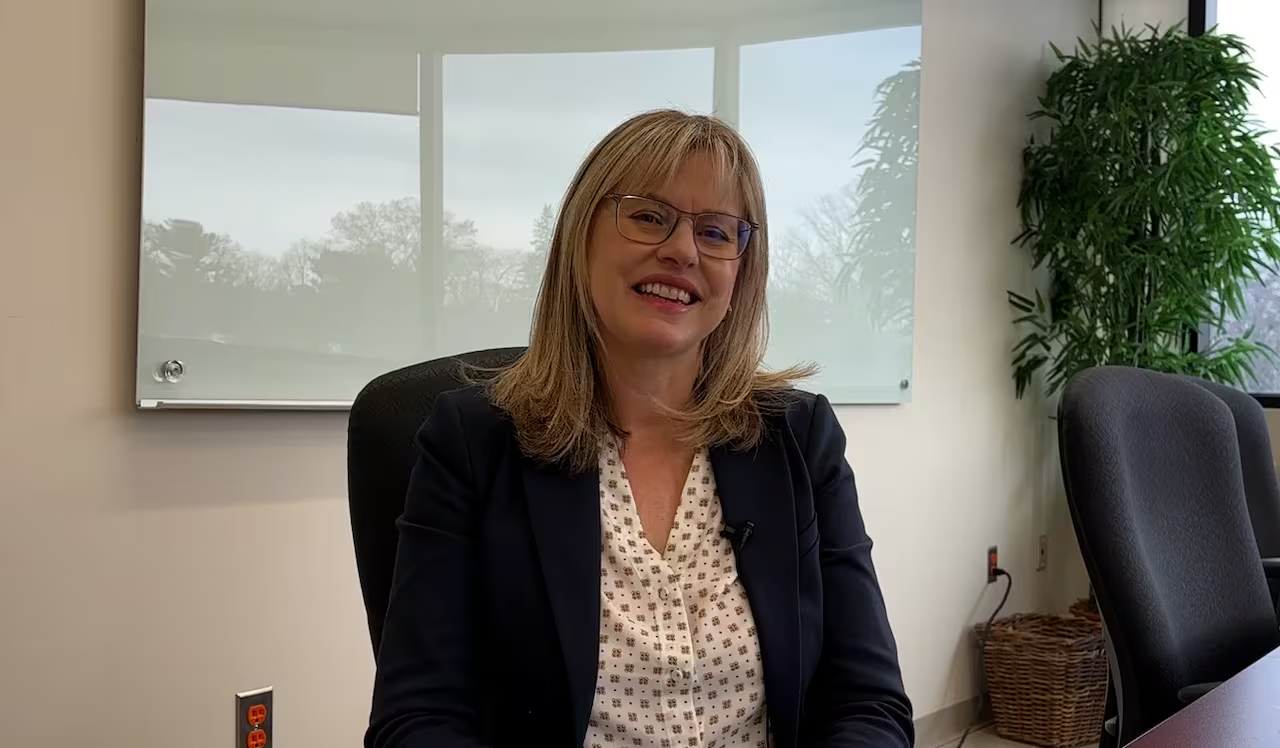
Aimee Nelson is a McMaster University professor in the department of kinesiology and the school of biomedical engineering. Aura Carreño Rosas/CBC
“It took some discussion with MS Canada to understand what was happening to my body and how it would heal and relapse and that’s been the course of the disease throughout my life,” she said.
Women are up to three times more likely to get MS than men, according to MS Canada.
Aimee Nelson, a professor in the department of kinesiology and the school of biomedical engineering at McMaster University, said the study was important, knowing that women’s health is under-researched.
“There’s a bit of catch-up happening here,” she said.
Nelson and Toepp originally wanted to work on helping people with their upper limb control, which could help them with eating, but after consultation with people diagnosed with MS, they realized people were more interested in “regaining balance and reducing fall risk,” said Nelson.
The system used for the story is called EMG biofeedback, which uses muscle activity to move a cursor in the computer.
“The anecdotal report is that people are very much enjoying the EMG biofeedback,” said Nelson.
She also said their preliminary data does show improvements using the method.
“But it’s preliminary, so I don’t want to make any statements that say we found a statistical finding at this stage,” said Nelson.
| ‘There’s still more of me’ |
Bouwman says she’s “very competitive,” so she doesn’t think about the movements.
“I’m really engaged in [the video game] and I’m not thinking about, [how to move]. This is the game and I’m on it,” she said.
She also liked that her Tetris workouts, while engaging and challenging, still leave her able to “go out for lunch after with my husband and we can walk a little bit,” whereas more traditional training left her drained.
Toepp said he chose Tetris because of its popularity and how simple the controls are.
“Really, in order for the method to work, it wouldn’t have to be Tetris,” he said. “But Tetris does a good job of capturing people’s attention.”

Bouwman said the study, which had her playing Tetris a few times a week while her limbs were connected to a machine, made her gain confidence in her own steps again. Aura Carreño Rosas/CBC)
Bouwman said the program has helped her a lot, though she started out feeling insecure due to her imbalance, but with time that went away.
Despite the pain she felt after each session, she said it was all “worth it,” because she feels, “more confident in [her] steps.”
“The fact that I can alternate feet on the stairs even though I’m still holding on is huge,” she said.
“And the fact that I can catch myself if I get bumped into and stabilized now as opposed to just completely falling over… that’s amazing.”
Bouwman was an early childhood educator, but had to quit. Her last flare up in 2019 was so bad she could only crawl. She said MS affects the whole body and mind, making people “go down a rabbit hole” that is quite depressing.
“I think with losing function over the years, you don’t realize what you take for granted,” she said.
“But these little successes just mean the world to me in my mental health that it’s not really the end of the story yet. There’s still more of me.”
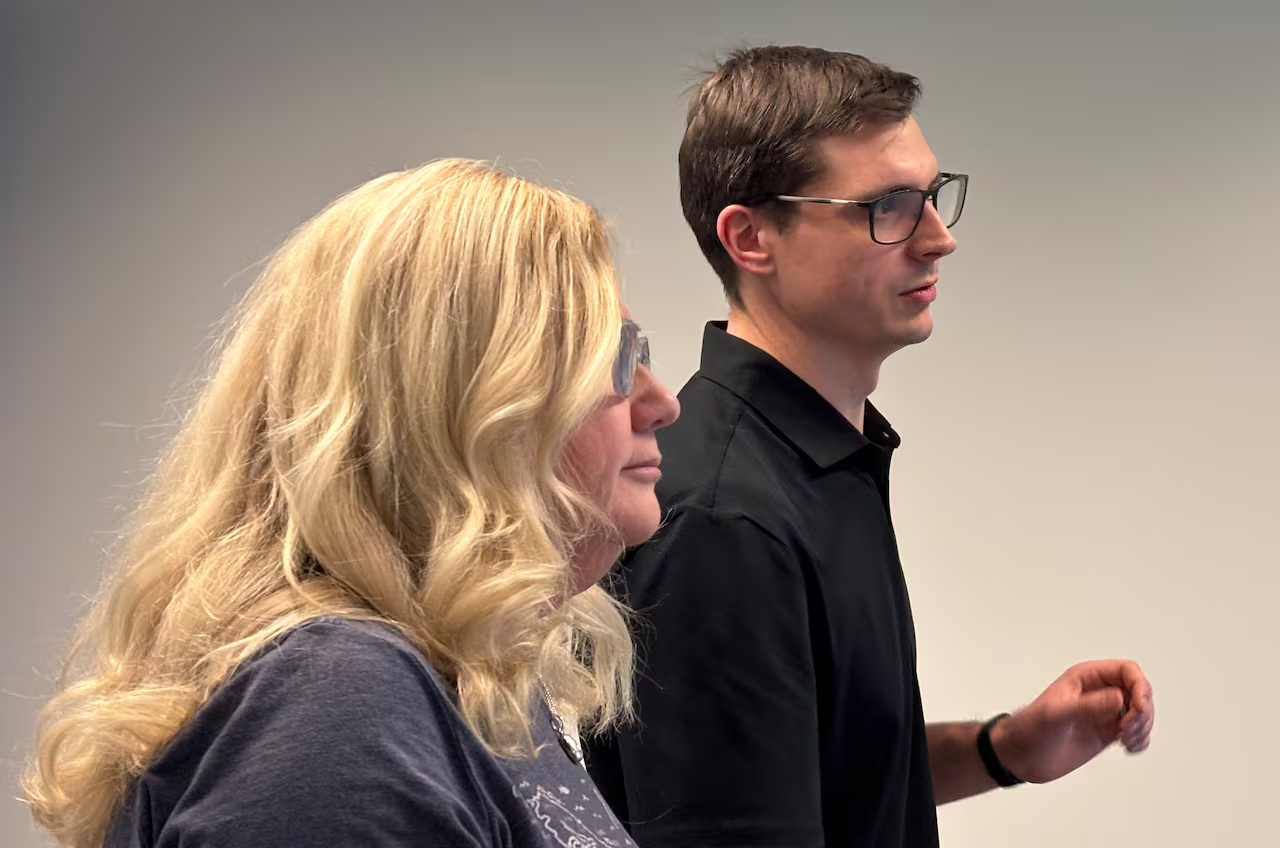
Stephen Toepp, right, came up with the study and said he chose Tetris because of its popularity and simplicity. Aura Carreño Rosas/CBC
| Further reading |
Game over for Tetris as a platform for cognitive skill training, Pilegard, Richard E. Mayer, Contemporary Educational Psychology, Volume 54, 2018, Pages 29-41, ISSN 0361-476X,
doi.org/10.1016/j.cedpsych.2018.04.003.
The social consequences of Machine Allocation Behavior: Fairness, interpersonal perceptions and performance, Houston Claure, Seyun Kim, René F. Kizilcec, Malte Jung, Computers in Human Behavior, Volume 146, 2023, 107628, ISSN 0747-5632, doi.org/10.1016/j.chb.2022.107628.
| Aura Carreño Rosas Reporter, CBC Hamilton |
| Aura Carreño Rosas is a reporter at CBC Hamilton. She’s originally from Venezuela. She has extensive experience in covering stories about immigrants and migrant workers as well as interesting people with diverse journeys. You can contact her at aura.carreno.rosas@cbc.ca |
 Source CBC News Hamilton
Also see
McMaster research targets menstrual cup ‘mess’ with absorbent tablets to tackle period stigma CBC
UBC researcher suggests multiple sclerosis may develop earlier than people think CBC
Alberta-developed VR technology aims to help Canada’s wheelchair curlers train for Milano-Cortina Paralympics CBC
Walk fast, live longer? McMaster University researchers say walking speed is an important health indicator CBC
Pickleball injuries on the rise, according to research and medical professionals CBC
Founder of Moose Jaw health centre suggests ‘ALS drug industry’ was behind CBC investigation of his business CBC
Long lineups are no sweat for these Londoners vying for spots in low-cost rec programs CBC