
Canada’s hospital emergency rooms have hit a breaking point. Is it the new normal?
Patients across the country can spend days on stretchers and in storage rooms waiting for beds.

Foothills Medical Centre in Calgary, seen on Sept. 8 last year, is one of many hospitals across Canada that’s facing crowding issues as ER backlogs, a lack of beds and an aging population all affect patient flow. David Mercer/CBC
Natalie Stechyson, CBC News Canada Mar 13, 2026
Six days in an overflow stretcher. Beds in storage rooms. Patients dying in their seats.
No, we’re not describing an episode of HBO’s gritty medical drama The Pitt. These are real-life scenes playing out in Canada’s emergency rooms.
From Carbonear, N.L., where a man recently died of a heart attack during a 10-hour wait to see a doctor, to Calgary, where a woman pleaded “please don’t let me die” during the hours she bled onto a stretcher in the ER, hospitals are bursting at the seams as backlogs and access issues affect patient flow.
“I think we’re close to the breaking point,” Dr. Margot Burnell, the president of the Canadian Medical Association (CMA), told CBC News.
The issue for emergency departments is that they can’t control who comes through their doors, said Burnell, a medical oncologist in Saint John, N.B. ERs are not only seeing increased numbers, but the patients that come through are also more medically complex.
This means longer wait-times both to see a doctor and to get a bed when a patient is admitted, Burnell explained. “Patient care, unfortunately, is being affected.”
In Winnipeg, some patients are waiting 20 hours or more to receive care. On Thursday afternoon, the children’s hospital CHEO in Ottawa had an estimated wait time of 15 hours and 47 minutes for non-urgent patients; in Summerside, P.E.I., the estimated wait time for non-urgent patients on Wednesday was more than 10 hours.
Meanwhile, the latest statistics published by Ontario Health show that patients who came to an ER in January and were admitted to hospital spent on average 20.3 hours in the emergency department before getting a bed in a ward. The average time spent on a stretcher in ERs across Quebec on Tuesday was 18 hours.
Doctors in Alberta have called for the province to declare a state of emergency over the overcrowding affecting emergency rooms, calling the situation a “crisis state.”
| WATCH | Patients at Newfoundland hospital have spent days in overflow |
| Two women say they spent days on stretchers after being admitted to the Western Memorial Regional Hospital in Corner Brook. One emergency room doctor says patient overflow is due to system failure. CBC |
| ‘Breaking point’ |
On March 3, Kingston Health Sciences Centre (KHSC) posted a message on Facebook. “The care you receive may look a little different in the coming weeks,” the message warned before going on to explain that KHSC had just recorded its highest number of admitted inpatients ever.
The post went on to warn about long wait times and noted that some patients “may be assigned to a bed in an unconventional space.”
The week before, the hospital admitted 636 patients in one day, far beyond the 570 beds it had available, KHSC CEO Dr. David Pichora told CBC News at the time. He said that they were holding patients in sun rooms, the gym, storage rooms and hallways.
Kingston is far from alone. Recently, a patient in Corner Brook, N.L., described spending six days on an overflow stretcher in a windowless room, while another described spending three days on a stretcher in “a little nook in the hallway where they store towels and blankets.”
In January, patients in Calgary detailed harrowing experiences waiting to be seen in ERs, including a woman who waited hours to be seen for a life-threatening postpartum hemorrhage as blood pooled beneath her.
| WATCH | Edmonton woman wants answers after husband dies in waiting room |
| The Alberta government has ordered a review after a 44-year-old Prashant Sreekumar died while waiting at Grey Nuns Community Hospital’s emergency department in Edmonton. CBC |
Just a few weeks earlier, Alberta ordered an inquiry into the death of a 44-year-old man who died while waiting to be seen by a doctor for chest pain at an Edmonton emergency department.
“The stories that you’re seeing coast-to-coast reflect that breaking point of the system that I think we’re unfortunately seeing manifest right now,” Dr. Michael Herman, an emergency physician in Ottawa and Vice Chair of the Canadian Association of Emergency Physicians public affairs committee, told CBC News.
“I’ve been doing this job coming up on 12 years now, and I think morale amongst the physicians is about as low as I’ve seen it. It’s a tough time right now, to be very frank.”
| Ongoing pressure on the system |
Canada had an average 2.5 hospital beds available per 1,000 people in 2023, according to a November 2025 report by the Organization for Economic Co-operation and Development (OECD). That’s well below the average of 4.2 beds across OECD countries. It means that Canada was ranked 28th out of the 35 countries measured that year.
By comparison, South Korea and Japan had 12 beds per 1,000 people.
| Hospital beds per 1,000 people in 2023. Source: Organization for Economic Co-operation and Development (CBC) |
Every emergency department strives to provide high-quality care, Herman said, but they often can’t due to system constraints.
For example, patients admitted to the hospital through the ER end up staying there because hospital rooms are being taken up by patients who can’t leave due to a lack of outpatient resources like long-term care and community supports.
As a result, he said, ERs are functioning “as the de facto boarding house for the hospital.”
Last month, the CEO of New Brunswick’s Horizon Health warned that the number of patients housed in hospitals because they don’t have a nursing home spot is getting worse, and the spillover is affecting ERs clogged with patients waiting for beds to open up.
| More primary care needs |
In addition, Canada has an aging, medically complex population that requires more access to primary care and chronic disease maintenance — which they aren’t getting, the CMA’s Burnell explained.
“For many of those illnesses, if they had good access to primary care, they might have gone in and had it treated before they became unwell,” she said.
A February report from the CMA found that 5.8 million Canadians lack access to primary care. Even those with family doctors say they don’t have enough access to them. Meanwhile, the November OECD report found that 9.1 per cent of Canadians reported they had unmet health-care needs, compared to the OECD average of 3.4 per cent.
None of this is new, Herman said, but now, the ongoing pressure on the system has reached a boiling point. And ERs are now the catch-all for every other access issue in the health-care system, whether it’s trouble getting in for an X-ray or accessing resources for Crohn’s disease.
“Emergency rooms become the conduit through which all these other issues flow,” he said.
| Is this the new normal? |
What these hospitals are facing may sound familiar.
A few years ago, the reports were about respiratory illnesses putting pressure on hospitals. Before that, it was COVID-19, staff shortages and closures.
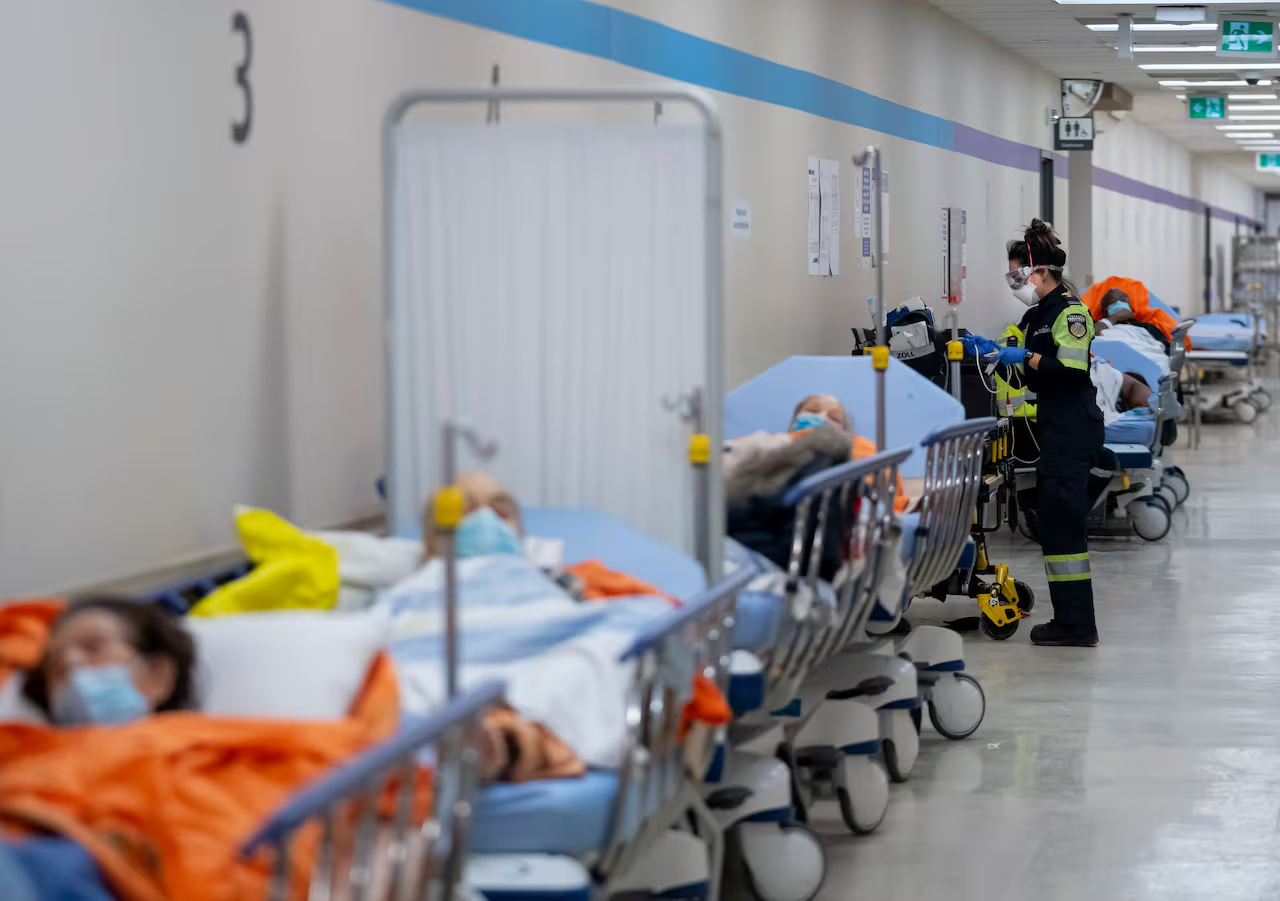
A few years ago, hospitals were facing pressure because of the COVID-19 pandemic, like this scene at the Humber River Hospital in Toronto on Jan. 25, 2022, when patients brought in by paramedics had to wait to be triaged in the hallway due to a crowded ER. Nathan Denette/The Canadian Press
In 2007, CBC reported on emergency rooms “bursting at the seams.”
That same year, the Canadian Institute for Health Information released a report describing patient flow issues as a factor in admitted patients sometimes waiting up to 24 hours for acute care beds.
In each of these instances, health-care professionals described hospitals at a breaking point.
“We’ve been telling the same story coming up on decades now,” Herman said. “I think we’re making it the new normal. I don’t think it has to be the new normal.”
“It’s an unfortunate norm that we really want to work on to improve,” Burnell said.
All of this paints a pretty bleak picture of the current state of Canadian health care, but Burnell and Herman agree there are solutions.
| WATCH | Long wait times shouldn’t be normalized, ER docs say |
| Emergency physicians who’ve worked for years at Winnipeg’s St. Boniface Hospital say an expanded emergency department won’t solve the underlying issues causing long wait times. CBC |
They start with dialogue at every level of government, as well as within the communities and health-care facilities themselves, they said.
Providing more primary care and long-term care services needs to be part of the solution, according to Herman, who also says Canada needs more doctors and more hospital beds, so staffing, training and infrastructure need to be priorities.
“Every physician wants the best care for their patients,” Burnell said. “It’s going to take some time, but there are solutions.”
| Clarifications |
| This story has been updated to remove an image of a patient transport bed in a hallway of St. Paul’s Hospital in Vancouver. The hospital said patients are not treated in hallways at St. Paul’s. Mar 13, 2026 1:52 PM MDT |
| Natalie Stechyson Senior Writer & Editor |
| Natalie Stechyson has been a writer and editor at CBC News since 2021. She covers stories on social trends, families, gender, human interest, as well as general news. She’s worked as a journalist since 2009, with stints at the Globe and Mail and Postmedia News, among others. Before joining CBC News, she was the parents editor at HuffPost Canada, where she won a silver Canadian Online Publishing Award for her work on pregnancy loss. You can reach her at natalie.stechyson@cbc.ca |
 Source CBC News Canada
Also see
St. Boniface Hospital doctors worry long wait times being normalized as ER might have set record CBC
Beds placed in halls and storage rooms amid record patient surge at Kingston hospital CBC
‘A terrible experience’: Patients spent days on overflow stretchers in Corner Brook hospital CBC
‘Please don’t let me die’: Calgary patients recount long waits in emergency rooms CBC
Hospital capacity crisis could soon affect surgeries, CEO says CBC
Roughly 500,000 Canadians left ERs before seeing a doctor last year, data shows CBC
Alberta government won’t say if promised new triage emergency doctors are on the job CBC