
CRO Study Wins JPO Article of the Year
The authors of a study about cranial remolding orthosis (CRO) wear time won the 2025 Journal of Prosthetics and Orthotics Article of the Year Award at the American Academy of Orthotists and Prosthetists Annual Meeting and Scientific Symposium being held this week in Nashville, Tennessee.
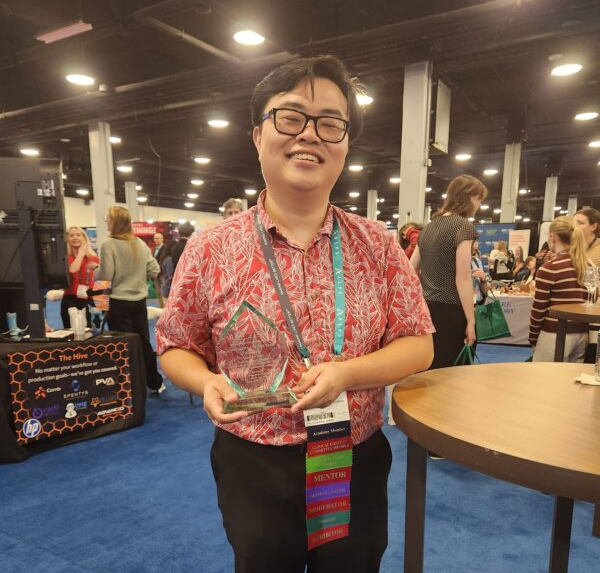
Thach. Photograph by Betta Ferrendelli
The study concluded that longer average CRO wear time was significantly associated with larger reductions in cranial vault asymmetry (CVA), cephalic ratio (CR), and cranial vault asymmetry index (CVAI) in infants with nonsynostotic deformational plagiocephaly.
Scott Thach, MSPO, CPO/L, first author of the article, accepted the award for “Cranial remolding orthosis study on the use of a temperature sensor to measure wear time.” The other authors were Jessica Corso, CO/L, FAAOP, Anthony Cimorelli, MSPO, CPO/LPO, Jaccalyn Owens, CPO/L, and Catherine Leigh Davis, CPO/L, FAAOP.
In the study, the authors noted a lack of evidence regarding the necessary CRO wear time to treat nonsynostotic deformational plagiocephaly. While a 23-hour daily wear schedule is generally prescribed to achieve a positive outcome regardless of presentation, the study compared daily wear time to treatment outcomes.
Sixty-nine infants ages three months to 18 months who were diagnosed with deformational plagiocephaly and initial CVA greater than 6 mm or a CR greater than 0.90 completed the study. The subjects were treated with an Orthomerica STARband CRO.
The children’s caregivers completed questionnaires reporting CRO adherence, and Maximum Integrated’s iButton temperature loggers recorded objective wear time. The researchers collected 3D head shape measurements via Orthomerica STARScanner, caregivers’ questionnaires, and iButton data every five to eight weeks.
The self-reported wear time was 22 hours per day. Measured wear time was 17-18 hours per day.
The authors suggested that increased sample sizing is required to determine if the results are generalizable to brachycephalic and asymmetrical brachycephalic head shapes.
| References |
Davis, C. L., Thach, S., Corso, J., Cimorelli, A., & Owens, J. (2024). Cranial Remolding Orthosis Study on the Use of a Temperature Sensor to Measure Wear Time. JPO Journal of Prosthetics and Orthotics, 37(2), 73–80. https://doi.org/10.1097/JPO.0000000000000527
| Further reading |
Trebilcock AL, Findley JL, Cherry JS, Kasparek JA, Gordon MM, Beals SP, Littlefield TR. A 10-Year Review of the Efficacy of Cranial Remolding Orthosis Treatment and Factors That Influence Outcomes for Infants with Isolated Deformational Plagiocephaly. Children (Basel). 2025 Aug 21;12(8):1099. doi: 10.3390/children12081099
Petz AM, Vallery CE, Richards CJ, Gensch HT, Yosef M, Khalatbari SH, Frank CJ, Richards JA. Time to successful outcome vs. treatment duration in cranial remolding orthosis treatment, Prosthet Orthot Int. 2025 Oct 1;49(5):502-507. doi: 10.1097/PXR.0000000000000388. Epub 2024 Nov 5. Full text, PDF