
Calgary high school students develop wearable technology for those with Parkinson’s disease
Tail-inspired tech designed to help users with their balance.
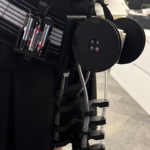
Grade 12 student Luotong Shi demos the wearable tail she and fellow student Allen Guo-Lu designed to help those battling Parkinson’s disease avoid serious falls. The team recently presented the design at the Canada-Wide Science Fair in Edmonton. Loren McGinnis CBC
Kelsea Arnett, CBC News Calgary Jun 02, 2026
Allen Guo-Lu and Luotong Shi aren’t your typical Grade 12 students.
While most are either busily preparing for final exams or revelling in the fact that their high school careers are almost over, Guo-Lu and Shi have spent their senior year developing wearable technology to help people battling Parkinson’s disease avoid serious falls.
“It’s our last year in Grade 12, so we were like, ‘Why don’t we try to kind of give back to the community?'” Shi told CBC Radio’s Calgary Eyeopener.
“This was one of the ways that we thought of doing it.”
The technology — a wearable battery-powered tail equipped with built-in sensors — can detect when the wearer may be unstable and act as a counterweight to help them regain their balance, Shi said.

Luotong Shi is a Grade 12 student at Western Canada High School in Calgary. She spoke to CBC Radio’s Calgary Eyeopener on Tuesday about the wearable tail she helped design. CBC
“It essentially works kind of like the idea of a spine where there is several pieces that you can attach and the tubes act as tendons,” Shi said.
In April, the Western Canada High School students won the University of Calgary Chancellor and Senate Award at the Calgary Youth Science Fair. The project was also a finalist at the Canada-Wide Science Fair in Edmonton last week.
There are at least 120,000 people living with Parkinson’s in Canada, and that number is expected to exceed 150,000 by 2034, according to Ko Currie with Parkinson Canada.
The Parkinson Association of Alberta estimates roughly 15,000 Albertans live with the disease.
Tremors and gait features like slowness, difficulty with balance or rigidity are some of the more recognizable symptoms of the disease, Currie said, adding falls are a significant concern.
“It’s one of the most disabling features of Parkinson’s, because they can lead to really serious injuries and sometimes even hospitalizations,” said Currie, who is the organization’s director of research programs and partnerships.
“If they get really bad or very frequent, it can lead to a loss of independence, accelerated decline.”
Having youth interested in developing solutions for the issue is great to see, Currie said.
“One of the biggest things we always try and shoot for is building what we call the research ecosystems in Canada for Parkinson’s,” Currie said.
“Whether that’s new young scientists, young investigators — the more people we can get into the field and working on Parkinson’s research, the more we’ll see big discoveries moving faster and faster and getting in the hands of real people that need it.”
| Why a tail? |
Guo-Lu said the project was inspired by his volunteer work in seniors’ homes and witnessing Parkinson’s patients struggling with balance.
He said the tail design comes from witnessing how cats and other mammals use their tails to balance and correct themselves.
“I think that was a really cool phenomenon, and so that’s why I sort of got into, ‘Hey, what if we just made a tail for humans?'”

Allen Guo-Lu says he came up with the idea for the wearable tail after volunteering in seniors’ homes and witnessing Parkinson’s patients struggling with balance. CBC
Guo-Lu said in testing the belt with several patients, they were able to see how the tail responded to various individual gaits and stages of progression of the disease.
“Learning about those factors and testing really helped us get a good design for the tail,” Guo-Lu said.
He added they can also change the weight of the tail depending on how much support a patient needs and what is most comfortable for them, although the ideal range was between 400 and 1,200 grams.
Users can also tailor the tail’s sensitivity to their body with an app the pair built.
| Project’s benefits go beyond Parkinson’s |
But the benefits of the tail extend beyond just patients with Parkinson’s, Shi said.
“This tail, because it addresses balance specifically, it honestly should benefit all people who have asymmetric gait,” she said.
“If there’s trouble with balancing or if walking assists are needed, we want in the future to implement this tail with these other walking aids, to be able to help people better provide an active balancing mechanism for them.”
| WATCH | New therapy could revolutionize treatment for Parkinson’s |
| A new Parkinson’s therapy called adaptive deep brain stimulation could revolutionize treatment for the disease, which afflicts one in 400 Canadians. CBC’s Christine Birak follows one patient’s journey with ADBS, and explains how it could be used to treat other neurological disorders. CBC |
Shi added participating in the project helped her decide to study electrical engineering when she attends the University of Waterloo in the fall.
“It kind of showed me how versatile different circuits can be,” she said.
For Guo-Lu, he’s going to be studying neuroscience at the University of Calgary, where he wants to keep learning about what causes neurological diseases like Parkinson’s.
“Parkinson’s is really, really complex, right? There’s a lot of things about the brain. I think there’s a big intersection there, and I think that’s a really cool topic.”
| Kelsea Arnett, Reporter |
| Kelsea Arnett is a reporter with CBC Calgary and part of the 2025 CBC News Summer Scholarship cohort. She worked as a researcher for CBC during the 2023 Alberta provincial election and previously worked as a reporter for the Globe and Mail. You can reach her at kelsea.arnett@cbc.ca |
 Source CBC Calgary
Also see
U of S researchers design rapid test to detect Parkinson’s sooner CBC
Sask. teen has ‘life-changing’ brain stimulation treatment for juvenile Parkinson’s disease CBC
Kitchener teen wins innovation award at Canada-Wide Science Fair, fixes 35-year-old problem CBC