
How to engineer a better ankle
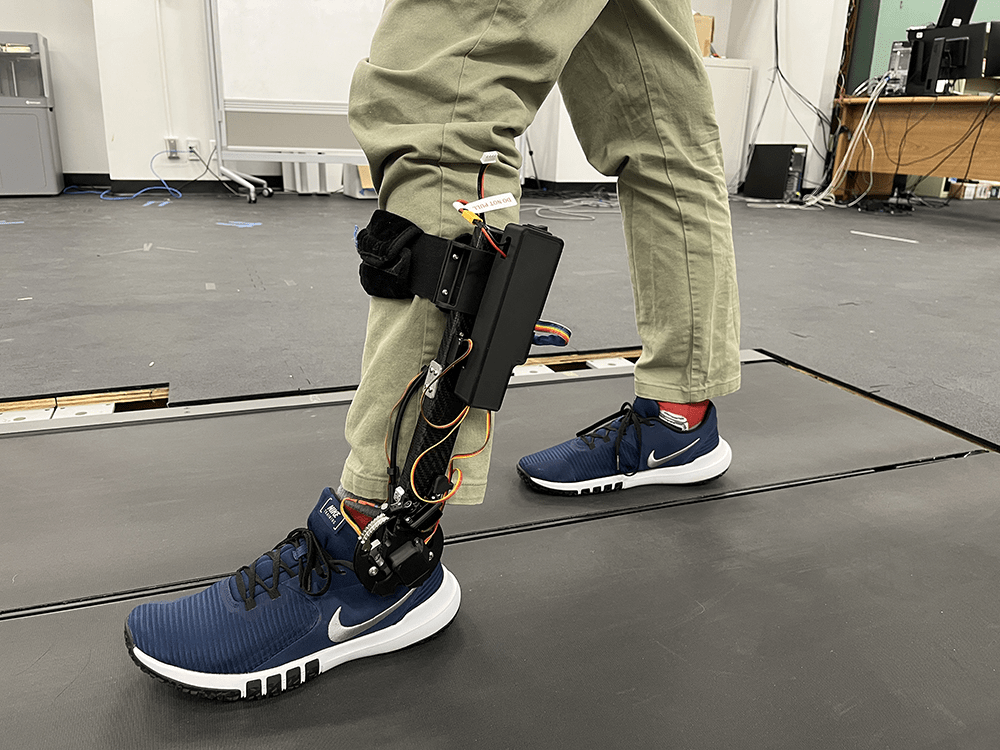
Researchers at Northern Arizona University (NAU) engineer better ankle function by developing lightweight, powered robotic ankle-foot exoskeletons and flexible carbon-composite orthotics to assist walking and restore natural mobility. Northern Arizona University
Heidi Toth, The NAU Review Aug 24, 2026
It only takes one sprained ankle to appreciate your ability to manage the stairs.
Now imagine, instead of a single injury, you have motor difficulties from a neurological disease that make stairs difficult or impossible all the time, not just for a couple of weeks. Imagine how much life could change with a wearable device that gave you the ability to take the stairs.
Sam Hopkins, a doctoral student at NAU, wants to make that experience universal. An award from the National Institutes of Health is helping him do that.

Sam Hopkins, PhD Student in Mechanical Engineering, Biomechatronics Lab, Northern Arizona University (NAU)
Hopkins, who is in his fourth year in mechanical engineering with professor Zach Lerner’s Biomechatronics Lab, won an F31 fellowship from the National Institutes of Health, which is given to doctoral students doing research training in health-related areas. With this funding, he’s building a flexible ankle orthotic device that helps children with cerebral palsy live and move more independently.
“I’m so thrilled that Sam has received this prestigious fellowship because he is one of the most talented, hardworking, deserving Ph.D. students I’ve ever had,” Lerner said. “This award will provide exceptional doctoral training while advancing a transformative robotic ankle-foot orthosis design that may significantly improve mobility for individuals with cerebral palsy. By pioneering this adaptive robotic bracing technology that responds to changing terrain, Sam’s work has the potential to redefine assistive care and facilitate independence.”
| Why a new device is needed |
Ankle orthotics already exist, but they’re stiff, like a ski boot or an ankle brace. They work for walking, but can hinder high range-of-motion activities like climbing stairs, getting in and out of a car and even sitting down or standing up. Hopkins’ device will offer greater flexibility, allowing the user to move more freely during typical activities and walk with greater stability and confidence.
It’s filling a gap in available and affordable assistive technology for this community.
“Right now, you have the fully passive, spring-like devices—they do one thing, and they do it really well—but they can’t adapt, versus the fully powered motorized exoskeletons that can do a lot of different things, but they’re heavy and bulky,” Hopkins said. “Our device is that bridge. It’s more lightweight than other devices, using smart and adjustable springs instead of a bulky motor; it’s kind of passive but it still has that adaptability we want.”
| Using Ironman, and a beloved relative, as inspiration |
Hopkins grew interested in this type of work from two simultaneous experiences when he was young. The first was seeing his grandfather dealing with the effects of cancer.
“He was a towering individual, and it was difficult for me to see how someone could lose those abilities due to cancer or other diseases,” he said. “It took three people to help him move, and I watched him struggle to do basic activities.”
At the same time, Hopkins went to the movie theater and watched Ironman use technology to augment his injured body. A superhuman transformation wasn’t an option, but what if technology could help an injured person do daily tasks more easily?
“I’ve fallen in love with the fact that I can build something and test it to see if it helps people,” he said. “Even finding something that doesn’t work, it might lead to something else. This project will hopefully help us understand the field and how people interact with orthotic devices.”
The Biomechatronics Lab is focused on inventing wearable robotic exoskeletons that restore neuromuscular function and augments mobility. In addition to this research, Hopkins has worked on a device aimed at reducing pain from osteoarthritis of the knee.
| Heidi Toth | NAU Communications |
 Source The NAU Review
| References |
Hopkins S, Gaudette C, Silveti MJ, Lerner ZF. Exploratory Assessment of Robotic Ankle Foot Orthosis Stiffness and Neutral Angle on Stair Ambulation in Individuals with Cerebral Palsy. Ann Biomed Eng. 2026 Jul 20. doi: 10.1007/s10439-026-04305-4. Epub ahead of print.
S. Hopkins, C. Gaudette, M. J. Silveti and Z. F. Lerner, A Machine Learning Framework for Activity Recognition With Robotic Ankle Foot Orthoses. IEEE Robotics and Automation Letters, vol. 11, no. 5, pp. 5922-5929, May 2026, doi: 10.1109/LRA.2026.3677751.