
Ankle-Foot Orthoses for children with Cerebral Palsy
Improving the evidence base for use of Ankle-Foot Orthoses for children with Cerebral Palsy.

SureStep birthday party.
Siri Merete Brændvik, Tobias Goihl, Quentin Michaudet, Karin Roeleveld, David Rusaw, Matthew Lawrence Wassall – Norwegian University of Science and Technology
Ankle-Foot Orthoses (AFOs) are the most common type of orthosis used for children with Cerebral Palsy (CP). They are used to improve function (such as improved walking), preserve muscle length and foot alignment and prevent progression of contractures and deformities.
The evidence base for the prescription, design and use of AFOs is limited. There are no clear standards on how to choose the best AFO for an individual child and no established methods to assess whether an AFO is used as intended.
| Current Research Areas |
| 1. Gait patterns in children with Cerebral Palsy and the effect of AFOs |
Children with Cerebral palsy who can walk, often do so with complex gait deviations. Gait pattern classification systems have been developed to systematically describe these gait deviations. We explore how a gait pattern classification system can be used to evaluate the effect of AFOs on gait kinematics and energy cost of walking.
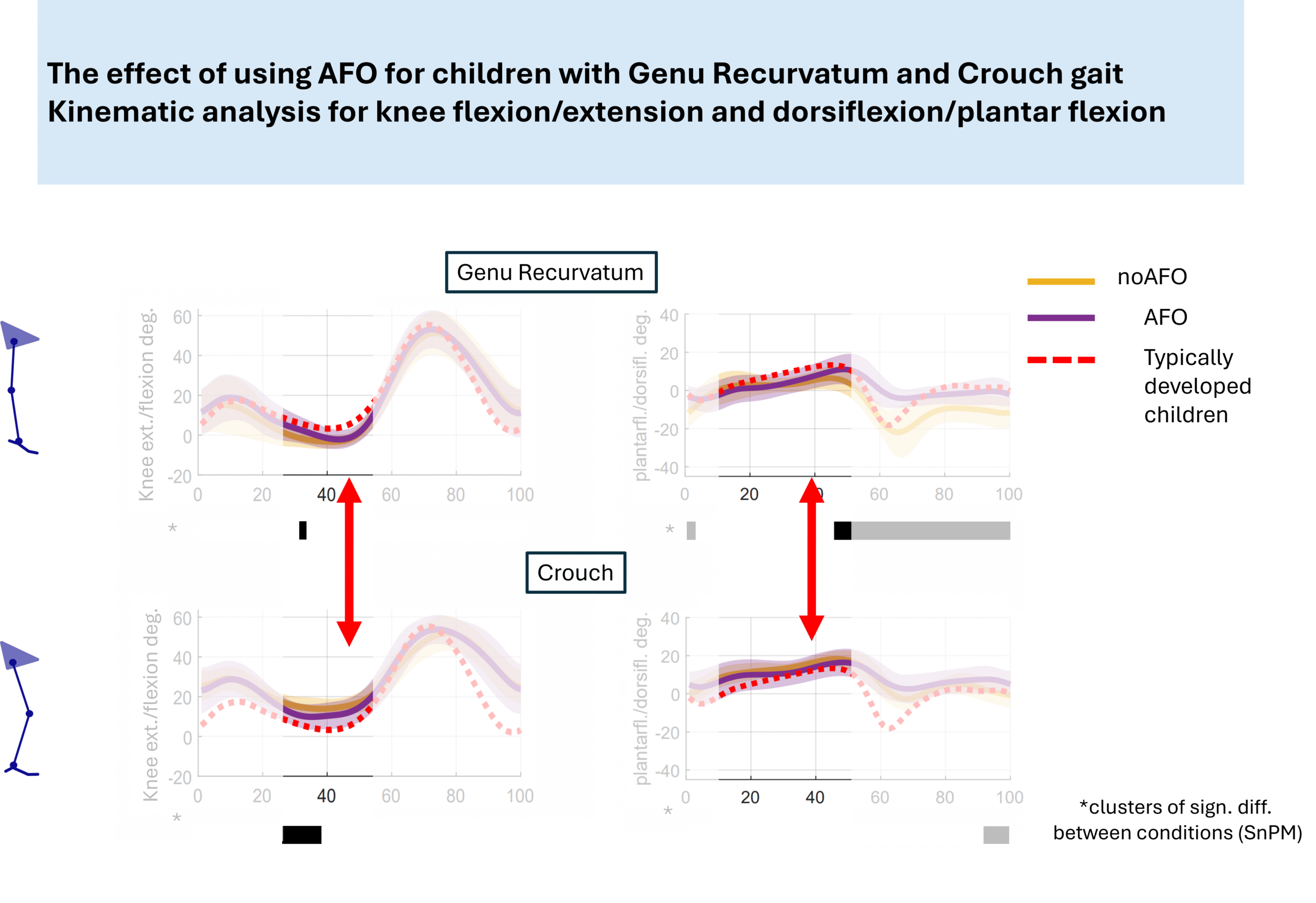
Click to enlarge
We have also explored current AFO provision practices for children with CP and investigated which AFO-designs Norwegian orthotists approve for several gait patterns.

Click to enlarge
| 2. Wearing behavior |
Very often practitioners recommend that children use AFOs 6-7 hours per day. In practice, we know very little about AFO wearing behavior and this is crucial when evaluating the effect of orthotic interventions.
MSc Student Ida Tamnes explores how we can use wearable sensors to detect AFO wearing behavior in children with CP.
In his MSc thesis, Quentin Michaudet investigated accelerometry and temperature sensors to detect whether AFOs are worn or not.
| 3. Activity patterns |
AFOs are often designed to improve gait. This gait assessment is done in the corridor of a clinic. However, we want AFOs to function as best as possible in real-life situations, but we do not really know what children are doing during the course of a week. To optimize orthotic design we need to be able to describe how much a child walks, runs or plays football.
This work focuses on the use of motion sensors to identify activity patterns in children with CP.
| Research Work |
- We have investigated the effect of AFOs on postural control and energy cost of walking
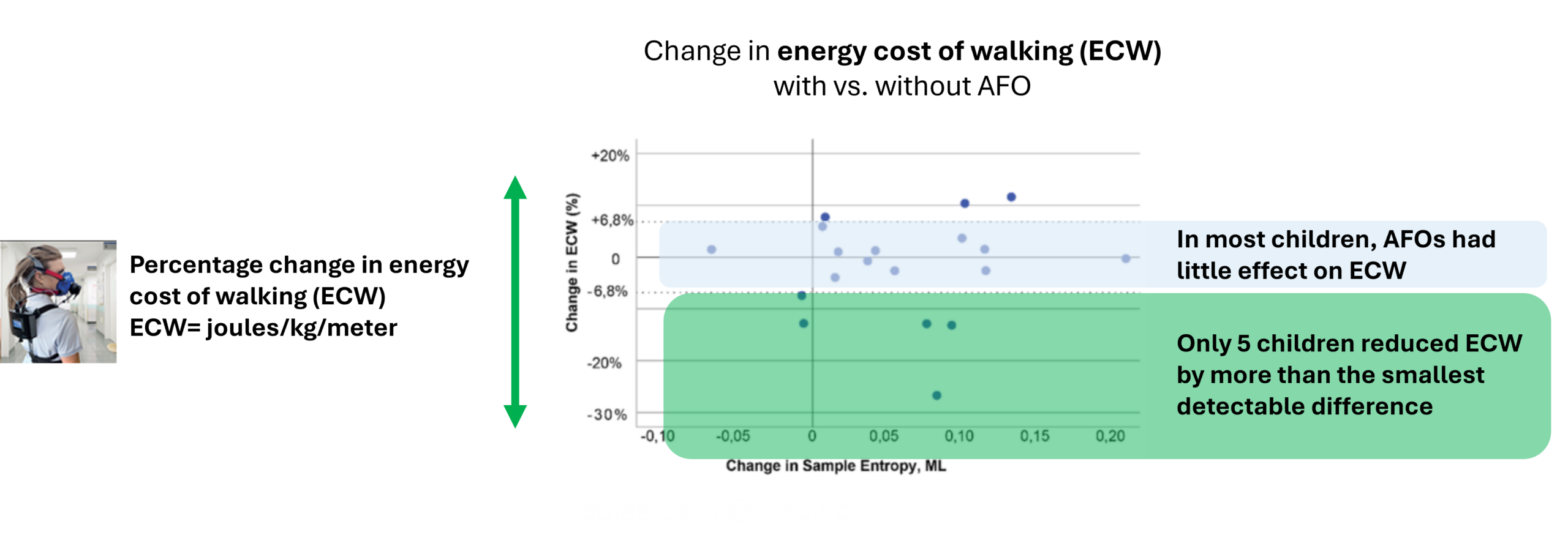
Click to enlarge

Click to enlarge
- We have investigated how AFOs are used in the home environment
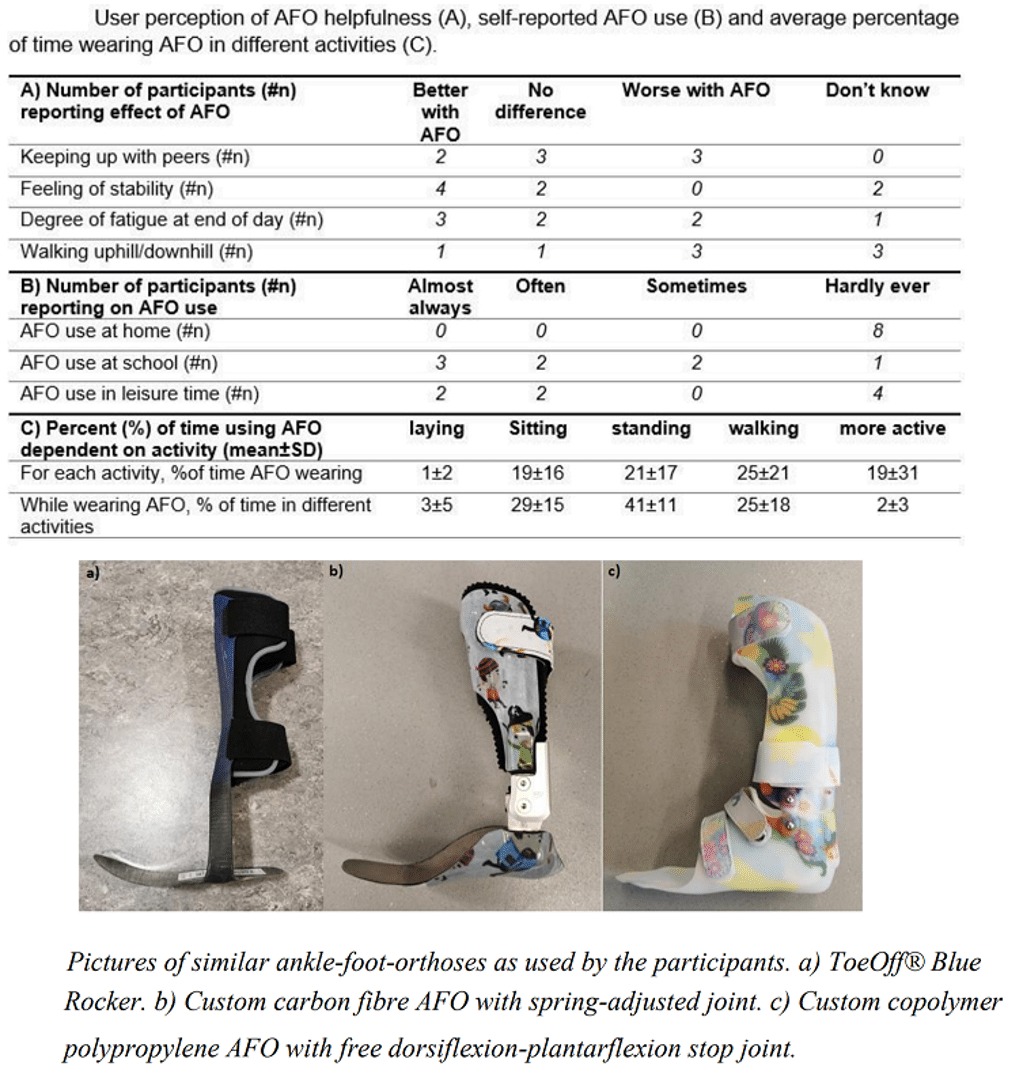
Click to enlarge
- We have investigated the effect of orthoses on gait related physical tests
| Publications |
Goihl T, Rusaw DF, Roeleveld K, Brændvik SM. Provision of ankle foot orthoses for children with cerebral palsy in Norway. Journal of Rehabilitation and Assistive Technologies Engineering. 2024;11.
Goihl T, Ihlen EAF, Bardal EM, Roeleveld K, Ustad A, Brændvik SM. Effects of Ankle-Foot Orthoses on acceleration and energy cost of walking in children and adolescents with cerebral palsy. Prosthet Orthot Int. 2021 Dec 1;45(6):500-505. PMID: 34561379.
Goihl, Tobias, Doctoral Thesis, Contributions to the evidence base of the provision of Ankle-foot orthoses to ambulatory children with cerebral palsy
Heggenhougen, Vera; Habitual Ankle-Foot-Orthosis use and user perception of AFO helpfulness in ambulant children with cerebral palsy
Gravdal, Johan, MSc Thesis, Change in performance of gait related physical tests with application of an orthotic solution in children with GMFCS level I or II and hemiplegia – an explorative study
Source  Norwegian University of Science and Technology
Also see
Your child’s equipment: Ankle foot orthosis MyHealth.Alberta.ca
Your child’s equipment: How to wear an ankle foot orthosis MyHealth.Alberta.ca
Your child’s equipment: Buying shoes to fit an ankle foot orthosis MyHealth.Alberta.ca