
U of C student living with POTS leads new study on long-term impacts of chronic condition
Postural orthostatic tachycardia syndrome primarily affects women of childbearing age .
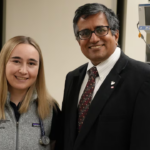
A new University of Calgary study on long-term care outcomes of patients with postural orthostatic tachycardia syndrome was led by Kate Bourne, left, and Dr. Satish Raj. Kristen Fong/Cumming School of Medicine
Amir Said, CBC News Calgary May 19, 2026
A Calgary student is drawing from lived experience with a neurological disorder to further the medical field’s understanding of it.
University of Calgary medical student Kate Bourne is the lead author of a new study on long-term care outcomes of patients with postural orthostatic tachycardia syndrome (POTS), a chronic condition she was diagnosed with at 24.
POTS, a disorder of the nervous system that primarily affects women of childbearing age, causes
The study, which involved 44 patients diagnosed over 20 years ago, suggests that while POTS did not disappear in the vast majority of long-term patients, almost half had their symptoms improve through treatment, time or a combination of both.
The University of Calgary estimates the condition affects up to 450,000 Canadians.
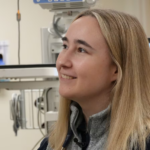
University of Calgary student and study lead author Kate Bourne was diagnosed with postural orthostatic tachycardia syndrome at 24, after first displaying symptoms over a decade beforehand. Now, at 36 years old, Bourne is looking to dedicate her career as a doctor and researcher to studying the condition. Kristen Fong/Cumming School of Medicine
POTS is a subject Bourne is all too familiar with.
“It actually took me 12 years to get a diagnosis of POTS,” said Bourne.
She says she first became sick at 12 years old, experiencing gastrointestinal symptoms and fatigue that doctors struggled to explain.
“I was a very active child,” she said. “I played lots of sports, horseback riding, music, and then all of a sudden I couldn’t get out of bed.”
The persistent unexplained symptoms forced her to do an extra year of high school and take eight years to complete her undergraduate degree, she said.
Now, at 36 years old, Bourne’s symptoms are well controlled with available treatments. While she still has bad days, she’s got a good hold on managing her condition.
“My career goal is actually to be a doctor and researcher studying POTS, so that hopefully other young women and girls don’t have to experience the challenges that I’ve experienced,” she said.
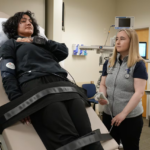
Rashmin Hira, left, takes part in research with Kate Bourne. Kristen Fong/Cumming School of Medicine
“It definitely helps me relate to research participants,” Bourne said on being a POTS patient herself.
“Oftentimes they’ll tell me that I’m the first person they’ve ever met who has POTS, and that helps to build the relationship in the research setting.”
Study lead Dr. Satish Raj, a professor with the university’s department of cardiac sciences, said the new findings offer a better understanding of the long-term outcomes for POTS patients.
“For most patients, it doesn’t go away,” he said. “Only two per cent of the patients reported that the symptoms totally resolved. That’s the bad news. The good news is that for almost half the patients, they report that over time their symptoms improved.”
Raj said this offers hope that interventions can lead to better functioning, even if not a complete return to normalcy.
“I think this is important news for patients, but also for physicians to say this is actually something that is serious and we’re going to need to treat,” Raj said.
| Amir Said, Reporter/Editor |
| Amir Said is a multimedia journalist with CBC Calgary. He is an alumnus of the University of Regina, and his award-winning work as a writer and photographer has been published by outlets across Canada, including Postmedia, The Hill Times and The Narwhal. Amir can be reached at amir.said@cbc.ca or through social media. |
| With files from Ted Henley |

Source CBC News Calgary
| References |
Long-term outcomes in patients with postural orthostatic tachycardia syndrome with an average follow-up of over 20 years. Bourne KM, Gamboa A, Black B, Hall J, Biaggioni I, Shibao CA, et al. J Intern Med. 2026;1–13. https://doi.org/10.1111/joim.70104
Patients With Postural Orthostatic Tachycardia Syndrome Have Different Experiences in Health Care in Canada and the United States. Hall J, Bourne KM, Stiles LE, Sheldon RS, Shibao CA, Okamoto LE, Garland EM, Gamboa AC, Diedrich A, Biaggioni I, Robertson D, Raj SR. Can J Cardiol. 2021 Oct;37(10):1683-1684. doi: 10.1016/j.cjca.2021.07.017. Epub 2021 Aug 8.
Also see
UCalgary research dispels long-held myth about POTS University of Calgary
Postural Orthostatic Tachycardia Syndrome (POTS) Johns Hopkins Medicine