
Finding Ease in a Body with Cerebral Palsy
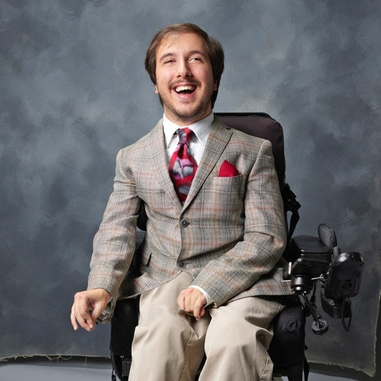
Greg Moomjy writes about how growing up with cerebral palsy affects his life as a disabled adult.
Greg Moomjy, New Mobility February 20, 2026
I woke up one morning when I was 2 needing a tissue. Like any 2-year-old wanting to blow his nose, I picked one up. However, as a 2-year-old with cerebral palsy, I wasn’t quite sure how to do it.
I decided to take it one step at a time. I tried to transfer the tissue from my right hand to my left, but my right hand wouldn’t let go. I ripped the tissue to shreds.
The lesson was obvious to me: my right hand was useless. I vowed never to use it again. From then on, my right side was dead to me. This is the story of how 33 years later, I started using my right hand again.
Sadly, thanks in part to that experience, the only thing I really understood about my CP growing up was that it affected my right side. One of the things I find most interesting about growing up with CP is how little I was taught about it.
For the longest time, I superficially related to my disability: It was why I used a wheelchair, wore leg braces and had countless surgeries. It was also the reason I had an Individualized Education Program as well as physical and occupational therapy. In short, my understanding of CP was driven by the medical model.
Simply put, the medical model views disability as an imperfection that only doctors can fix, with the goal of getting the disabled individual as close to the nondisabled ideal as possible. I don’t think it’s any exaggeration to say that the medical model is a very sinister way of relating to disability. It insidiously removes the individual from their own care and, by extension, their own life. It gives doctors and caregivers ownership of the knowledge of how CP affects your body. They become the only people who can make medical decisions for you.
As I got older, I began to see the holes in this approach. Still, years of adhering to it had left me feeling that my physical condition could not be improved. I thought this until a few months ago, when an opera singer changed my life.
I had seen her on YouTube discussing life as a performer with ambulatory CP. We got to know each other through collaborating on several projects. Having lunch with her during rehearsals gave us the time to chat about our own experiences with CP. We became friends, and she soon started couch surfing at my place.
Eventually, she told me about the Alexander Technique, a learning method that integrates your thinking and movement. According to her Alexander teacher, Ann Rodiger, “It is about posture, alignment, and coordination at all levels. It teaches the student how to participate in their own movements and what to focus on to make them easier and better.” I was skeptical at first, but when she told me that thanks to the Alexander Technique, she had minimal spasms and she could walk around her apartment holding a cup of hot coffee without spilling it, I had to give it a try.
My new opera friend attended my first lesson with Rodiger. The moment she and Anne put their hands on me, the first thing I noticed was the transfer of body heat. It made me think of doing hydrotherapy with my mom as a kid. I had this Pavlovian response and immediately fell into a relaxed stupor.
Over the next sessions, Rodiger completely changed my relationship to my CP. Once, after I apologized for a spasm, she replied, “Don’t apologize for your spasms,” then she added, “and stop running from your chair.”
I felt like someone had doused me in cold water. She elaborated, explaining that I was forcing my body to do what able-bodied medical professionals had instructed me to do, as opposed to allowing it to function how it wants to function.
If my body wants to spasm, she said I should just let the spasms occur. When I let them take their course, I feel looser for longer when they were over. Throughout this process, I learned so much about my body, like where my spasms start, and just how much mobility I have in my hands and spine, despite multiple surgeries and fixations. Soon, I noticed that different parts of my body would tingle just before I unlocked more function.
Imagine my joy when my right arm started to tingle. I had Ann get me a tissue, which I then ripped to shreds. This time though, I had people there to tell me not to give up.
Within a few days, I was passing a drumstick from one hand to another, even conducting Sousa Marches. As a disabled music student, I never thought I would be able to conduct.
Additionally, not only have I stopped taking muscle relaxers and postponed Botox, but I finally feel like I am in charge of my completely integrated body. As such, I can set goals for functions that matter to me. Best of all, I get to do this with my new friend.
We’ve developed a real sense of Crip Kinship. She’s been doing this for far longer than I have, but she hasn’t really done this with another disabled person so it’s a true joy to be on this journey of rediscovery together. I am so grateful to her.
| Other Articles by: Greg Moomjy |
 Source New Mobility
| Further reading |
Freeborn D, Knafl K. Growing up with cerebral palsy: perceptions of the influence of family. Child Care Health Dev. 2014 Sep;40(5):671-9. doi: 10.1111/cch.12113. Epub 2013 Oct 21. Full text
Vila-Nova F, Santos S, Oliveira R, Cordovil R. Parent-report health-related quality of life in school-aged children with cerebral palsy: A cross-sectional study. Front Rehabil Sci. 2022 Dec 5;3:1080146. doi: 10.3389/fresc.2022.1080146. Full text, PDF
Also see
Adulting With CP New Mobility
More Than the Chair: My Journey of Resilience and Unapologetic Living A Professional Patient